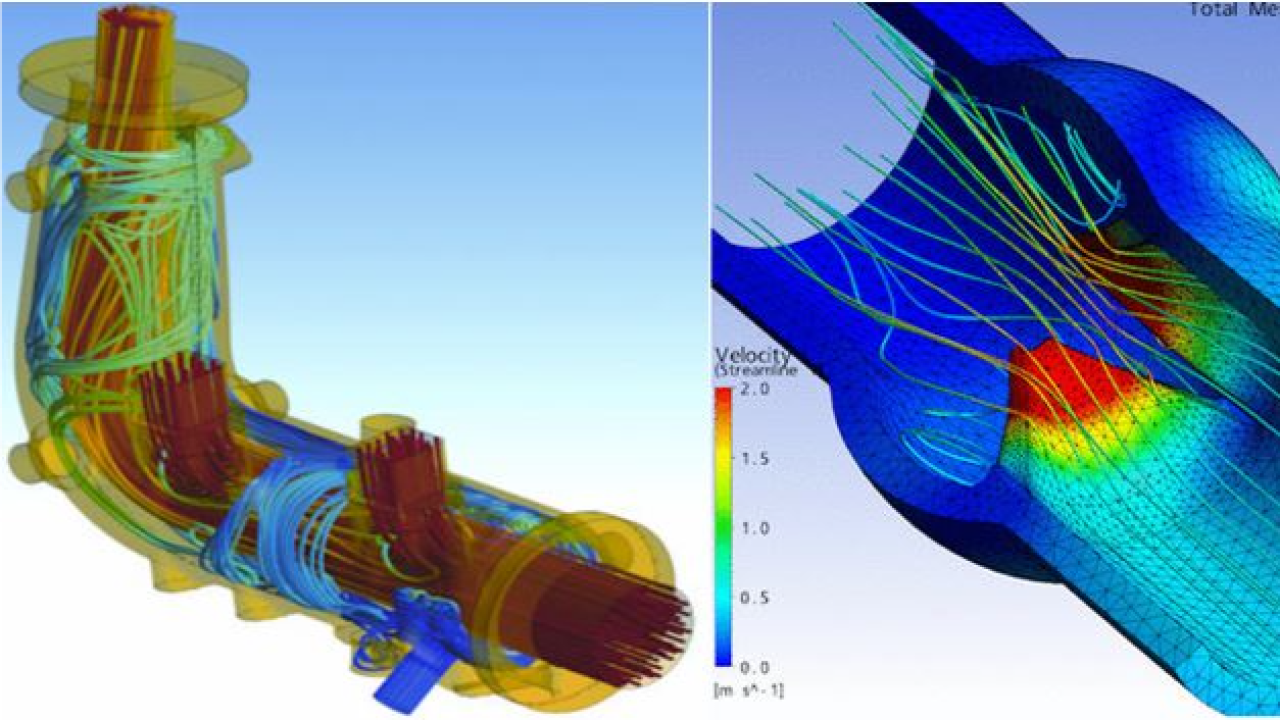
Join us for an intensive two-day workshop on Fluid-Structure Interaction (FSI), a critical multiphysics simulation technique used to understand how fluids and structures interact under real-world operating conditions. FSI plays a vital role in numerous engineering applications where fluid flow exerts pressure and thermal loads on structures, resulting in deformation that can, in turn, influence the fluid flow itself.
As products become more advanced and performance demands continue to increase, understanding the coupled behavior between fluids and structures is essential for ensuring safety, reliability, durability, and optimal performance. Through the power of ANSYS simulation, engineers can accurately predict and analyze these interactions, helping organizations minimize risks, improve product quality, and accelerate innovation.
This hands-on workshop will provide participants with practical exposure to FSI methodologies, simulation workflows, and industry best practices. Attendees will gain valuable insights into solving complex engineering challenges involving structural deformation, fluid dynamics, thermal effects, and multiphysics coupling using ANSYS solutions.
Agenda Highlights
Introduction to Fluid-Structure Interaction (FSI)
Fundamentals of Multiphysics Simulation
Understanding Fluid and Structural Coupling Mechanisms
Pressure-Induced and Thermal Load Effects on Structures
FSI Workflow in ANSYS
Structural Deformation and Flow Behavior Analysis
Case Studies and Industrial Applications
Best Practices for Accurate FSI Simulations
Hands-on Demonstrations and Practical Exercises
Interactive Q&A and Technical Discussions
What Attendees Will Learn
Fundamentals of Fluid-Structure Interaction (FSI) and Multiphysics simulation.
How fluid pressure and thermal loads affect structural performance.
Techniques for modeling coupled fluid and structural systems.
Best practices for setting up and solving FSI simulations in ANSYS.
Methods for analyzing structural deformation caused by fluid flow.
Understanding how structural changes impact fluid behavior.
Applications of FSI across aerospace, automotive, energy, marine, and industrial sectors.
Approaches for improving product safety, reliability, and longevity.
Industry workflows for solving real-world engineering challenges.
Interpretation and validation of FSI simulation results.
Mechanical Engineers
Structural Engineers
CFD Engineers
Simulation and CAE Engineers
Product Design Engineers
Aerospace Engineers
Automotive Engineers
Thermal Analysis Engineers
R&D and Innovation Teams
Engineering Consultants
Researchers and Academicians
Engineering Students interested in Multiphysics Simulation